
Managing maintenance for a retail chain with stores across several European countries involves far more than fixing breakdowns. You need to coordinate technicians, priorities, budgets, regulations, trading hours and different service levels without losing visibility over what is happening at each location. A maintenance provider for retail chains in Europe should turn that complexity into a centralised, measurable and repeatable operation, while retaining the ability to respond locally.

What changes when maintenance is managed across Europe?
A retail chain expanding internationally can easily end up building its maintenance network country by country: one HVAC provider in France, another electrical contractor in Germany, separate companies for emergencies, cleaning or automatic doors, and different procedures in each market. The problem arises when the supplier network grows faster than the internal team’s ability to coordinate it.
The consequences are not purely administrative. Fragmentation makes it harder to compare costs, monitor resolution times, identify recurring incidents and maintain consistent technical standards. For Operations, Facility Management or Expansion teams, every additional provider means more communications, invoices, contracts, data and working methods to supervise.
Working with a provider capable of coordinating multiple countries introduces a different model: management is centralised while the work itself continues to be carried out close to each store. Head office can establish common priorities and procedures while retaining access to technical capability suited to each local market.
The workflow should remain easy to understand even within an international organisation: the store reports an incident, it is coordinated through a central point, the appropriate local professional is assigned, the intervention is carried out and all information returns to the system for monitoring and analysis. Centralisation works when it simplifies the process without distancing execution from local realities.
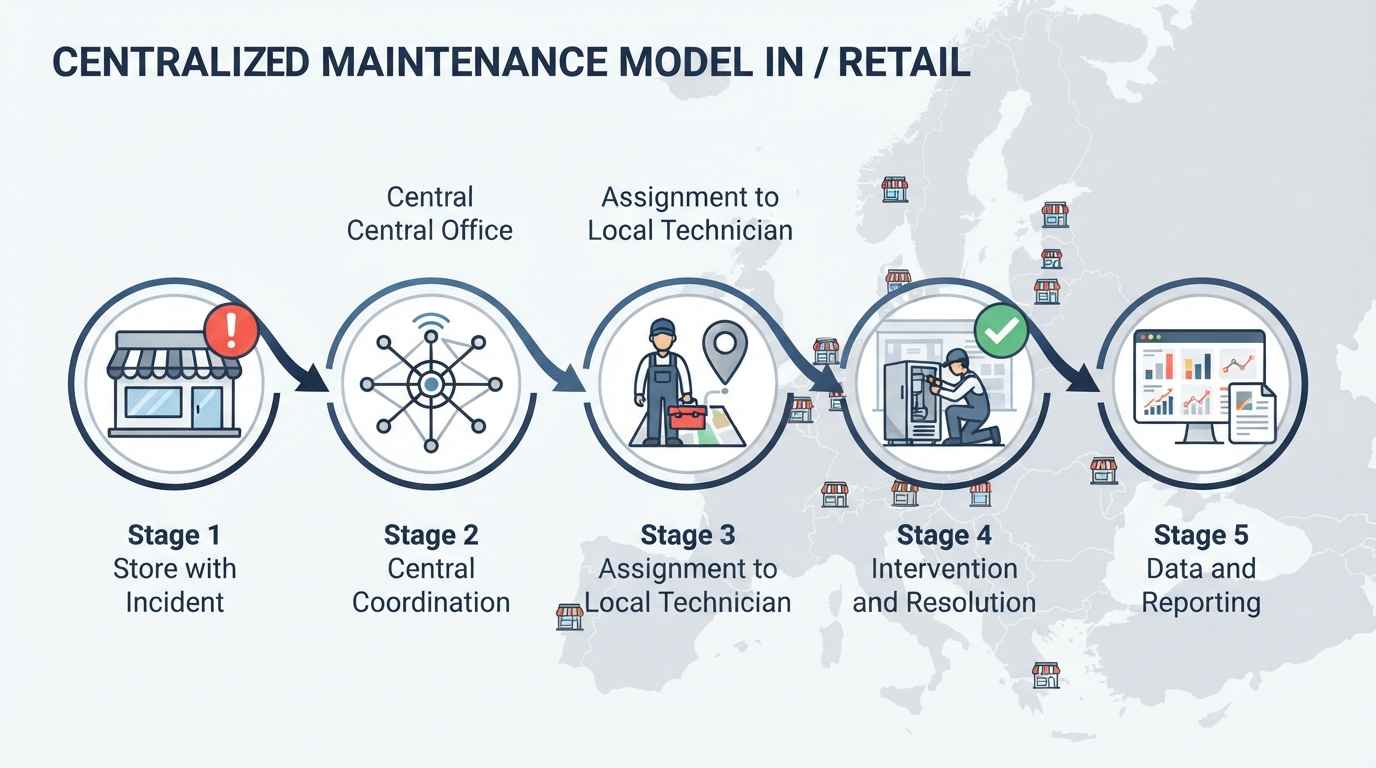
- A common operating model: consistent procedures for logging incidents, validation, intervention and closure.
- Greater comparability: structured data and costs using equivalent criteria across locations and countries.
- Fewer points of contact: the internal team avoids having to coordinate multiple local companies individually.
- Easier expansion: new stores can be incorporated into an operating structure that is already in place.
The aim, therefore, should not simply be to reduce the number of suppliers. The real advantage lies in reducing complexity without losing control over quality, costs and the outcome of each intervention.
Benefits of using a single maintenance provider for a retail chain
Centralising maintenance can be particularly valuable when a retailer operates dozens or hundreds of locations with recurring requirements. In that environment, each incident should be viewed as part of a network rather than as an isolated event. A fault that occurs repeatedly across different stores may reveal an issue with equipment, design or preventive maintenance that would be much harder to identify if the information were fragmented.
At Optima Retail, we work with precisely this multi-site approach. We integrate different technical specialisms within our retail maintenance services, allowing clients to centralise operational coordination without having to manage each technical trade separately.
Less coordination work for internal teams
When every location relies on different providers, a significant part of the Facility Management workload consists of finding technicians, requesting quotations, chasing updates and checking that each incident has been properly closed. A single point of contact allows that effort to shift from day-to-day coordination towards monitoring results.
The difference becomes particularly noticeable when several incidents need to be managed simultaneously in different countries. Rather than rebuilding the process from scratch each time, head office works within a familiar procedure and can focus on the exceptions that genuinely require a decision.
A common standard across the entire network
The brand experience also depends on the physical condition of the stores. Lighting, climate control, access systems, cleaning and finishes all affect how a location operates and how customers perceive it. Common procedures help ensure that a store in Madrid, Paris, Milan or London is managed to the same standard, even when execution is adapted to local requirements.
Consistency does not mean applying exactly the same technical solution in every country. It means setting shared criteria for priorities, expected quality, documentation, validation and closure so that service levels remain recognisable throughout the network.
Better information for decision-making
The provider should be able to turn maintenance activity into useful data: ticket volumes, response times, cost per store, repeat faults, incident categories or the performance of particular assets. Reporting stops being an administrative exercise when it helps identify patterns and prioritise investment.
A retail chain may discover, for example, that a particular family of equipment accounts for an unusually high proportion of incidents, or that certain stores have significantly higher maintenance costs than others. This makes it possible to move from simply reacting to problems to deciding where action should be taken earlier.
The ability to combine prevention and response
A retail network needs breakdowns to be resolved, but a mature operation cannot rely exclusively on corrective maintenance. Through our preventive maintenance service, we schedule inspections designed to identify deterioration before it disrupts trading. The larger the network, the more valuable it becomes to anticipate recurring problems rather than resolving them one store at a time.
Information gathered during corrective interventions should also feed back into the preventive maintenance plan. If the same fault begins to appear across several locations, reviewing the rest of the network may be more efficient than waiting for further breakdowns to occur.
How to choose a maintenance provider for retail stores in Europe
A commercial proposal may include an extensive list of services and countries, but that does not necessarily mean the provider can manage an international network effectively. The assessment should focus on what happens when a real incident occurs: who receives the request, who sets its priority, which technician attends, how the work is documented and who verifies the outcome.
Before comparing prices, it is worth assessing the complete operating model. Two commercially similar proposals can involve very different levels of coordination, traceability and coverage. There are seven areas that should be assessed together: coverage, retail expertise, technical capability, service levels, traceability, quality control and reporting.
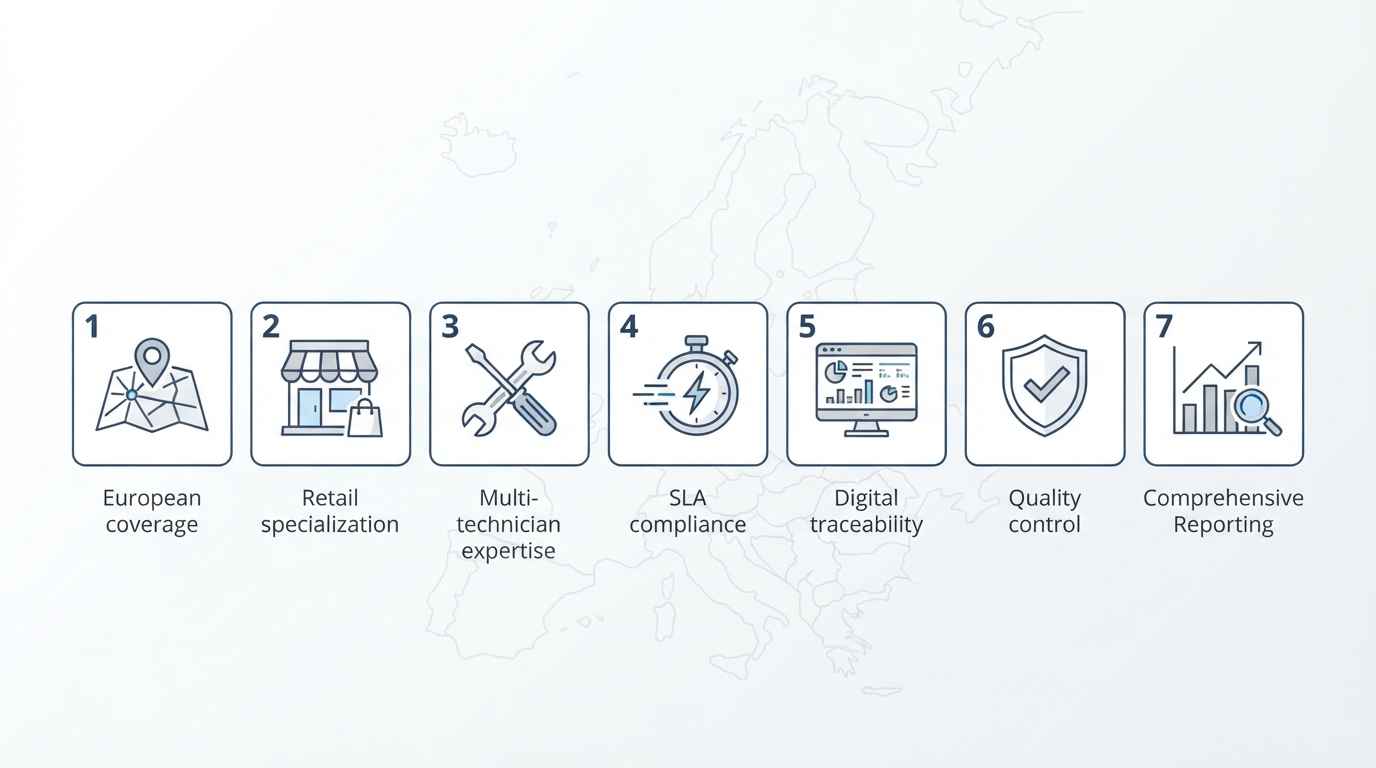
- Proven geographical coverage. Check that the provider can genuinely operate in the countries and cities where your stores are located and that it has a process for adding new locations. A European coverage map alone is not enough: you need to understand how the service is actually delivered in each territory.
- Retail expertise. A store open to the public has trading hours, seasonal peaks, access requirements, brand standards and operational priorities that differ from those of an office or industrial site. Those realities should already be built into the provider’s operating procedures.
- Multi-technical capability. Assess how many requirements can be managed through the same system: electrical maintenance, HVAC, fire protection systems, automatic doors, cleaning, pest control, refurbishments or energy efficiency, among others.
- SLAs and emergency support. Service levels should specify priorities, escalation procedures and commitments for each type of incident, including what happens outside normal trading hours.
- Digital traceability. Every intervention should leave a record covering the initial request, diagnosis, work carried out, materials, photographs, costs and closure. An international chain needs access to this information without relying on scattered email threads.
- Quality control. Ask who verifies that the work has been completed correctly and how complaints, repeat visits and recurring incidents are handled.
- Consolidated reporting. Head office needs to compare stores, countries, incident categories and costs using common criteria so that maintenance activity can be converted into management information.
These criteria are interconnected. Extensive coverage has limited value if the provider cannot offer traceability; a demanding SLA means little without sufficient technical capability; and collecting large volumes of data is of little use if they cannot subsequently be compared. The selection process should assess the operating system as a whole rather than each attribute in isolation.
In our case, Optima Retail’s international coverage extends across more than 50 countries. For a retail chain, that reach becomes meaningful when it is supported by a consistent coordination and monitoring model regardless of where an incident occurs.
What to include in a European retail maintenance RFP
A well-designed RFP makes it possible to compare providers on the basis of operational capability rather than price tables alone. The more specific the information requested, the easier it becomes to distinguish between commercial coverage and genuine delivery capability.
We recommend describing the store estate, countries, types of installation, trading hours and approximate intervention history. All candidates should then respond to the same points so that the comparison remains consistent.
- Coverage map by country and region.
- Technical specialisms included and services excluded.
- Complete process from ticket creation to closure.
- Priority matrix and associated SLAs.
- Out-of-hours service arrangements.
- Approval process for quotations and additional works.
- Quality control procedure.
- Reporting model and available KPIs.
- Management of local technicians and subcontractors.
- Escalation process for unresolved incidents.
- Document management and requirements applicable in each country.
- Process for onboarding new stores.
- Invoicing model and cost breakdown.
It is also useful to give candidates a number of realistic scenarios. Examples might include an electrical fault before opening, air conditioning failing during a period of high temperatures or an automatic door becoming stuck on a busy Saturday. A provider’s response to a specific scenario often reveals more about its operational capability than a corporate presentation.
The RFP should ask the provider to explain step by step how it would respond, what information the store would receive, who would take responsibility for coordination and what evidence would remain once the intervention had been completed. This makes it considerably easier to compare operating models and identify hidden dependencies.
SLAs and emergencies: what should be agreed before signing?
“Fast response” is far too vague a commitment for an international retail chain. The contract should establish what constitutes a critical, urgent, standard or planned incident and what commitment applies to each level. A useful SLA removes ambiguity when a store has a problem.
It is also worth distinguishing between acknowledgement time, assignment time, technician arrival time and resolution time. An incident may be acknowledged administratively within minutes and still remain unresolved for hours. The appropriate measure depends on the actual impact of the fault on trading activity.
At Optima Retail, our 24/7 emergency service for retail is designed for incidents requiring action outside standard maintenance cycles. Round-the-clock availability is particularly important for chains with long trading hours and locations spread across different countries.
Before appointing a provider, we also recommend checking what happens if the first intervention does not resolve the problem. Escalation procedures, access to specialist technicians and the management of follow-up visits should all form part of the operating model. Measuring arrival speed alone can hide poor first-time resolution performance.
Warning signs when comparing maintenance providers
European coverage requires a balance between central coordination and local knowledge. Proposals that promise very broad coverage without clearly explaining how that coverage is structured deserve closer scrutiny, particularly regarding who actually carries out the work and how the result is controlled.
It is also worth examining any model that still requires the client to coordinate a large proportion of the operation. If head office has to contact different companies, manually consolidate reports or repeatedly intervene to obtain updates, the apparent centralisation may simply be transferring the workload back to the internal team.
- Very low prices without a clear breakdown: these may conceal additional charges for travel, emergencies, management or materials.
- Ambiguous SLAs: phrases such as “as soon as possible” make it difficult to enforce a defined service level later.
- Limited traceability: without a clear history, analysing costs and recurring faults becomes difficult.
- No closure control: completing a site visit does not necessarily mean the incident has been resolved.
- Insufficient reporting: receiving invoices and technical job sheets is not a substitute for consolidated performance reporting.
- Dependence on specific individuals: the operation should continue to function even if an account manager or technician changes.
The final test is to imagine how the arrangement will work on an ordinary day after the contract has been signed. A strong operating model should make the network easier to manage as it grows, not more difficult.
Which KPIs show whether the provider is performing?
Selecting the provider is only the beginning. Once the service has been implemented, the relationship should be assessed using indicators agreed in advance. KPIs should measure operational outcomes rather than activity alone: a high number of visits or closed tickets means little if the same faults keep returning.
The right combination will depend on the business, but for a retail chain it is generally useful to review trends by location, country and incident category. This makes it possible to distinguish isolated problems from those requiring a more structural decision.
- Average response and resolution time by priority level.
- Percentage of SLA compliance.
- First-time fix rate.
- Repeat incident rate.
- Maintenance cost per store.
- Balance between preventive and corrective maintenance.
- Number of incidents by technical category.
- Trend in assets with recurring faults.
- Store satisfaction following each intervention.
When analysed together, these indicators help determine whether it makes more sense to repair, replace, increase preventive maintenance frequency or review a technical specification shared across several stores. Maintenance therefore moves from simply responding to incidents to providing information that improves management of the entire store estate.
Frequently asked questions about maintenance providers for European retail chains
When a retail chain begins considering a centralised model, questions often arise around coverage, local suppliers and integration with existing processes. There is no single formula that suits every retailer, but there are several questions that should be resolved before the service is rolled out.
The answer will depend on the number of stores, countries, installations and volume of incidents involved. A smaller network of highly standardised stores will have different requirements from a growing chain operating several retail formats.
Is it better to appoint one European provider or a different provider in each country?
It depends on how the retail chain is organised. If every country has an autonomous team capable of managing suppliers locally, a country-by-country model may be workable. Where the objective is to centralise operations, reporting and standards, a multi-country provider can reduce fragmentation and simplify governance from head office.
The decision should not be based solely on the number of suppliers. It is worth considering how much coordination work the organisation wants to retain internally and how important it is to have a consolidated view across the entire network.
Does using a single provider mean using the same technicians in every country?
Not necessarily. What matters is having common coordination and a delivery network suited to each territory. Consistency should come from the process, service level and quality control, even if the professionals physically carrying out the work are local.
Which maintenance services should be centralised?
This will depend on the chain, although recurring services required across many locations are often strong candidates: electrical maintenance, HVAC, fire protection, access systems, cleaning, preventive maintenance, corrective maintenance and emergency support. The more widespread a requirement is across the estate, the greater the potential benefit of managing it through common criteria.
How can a provider be tested before rolling it out across Europe?
One option is to begin with a representative group of stores or countries and define in advance which metrics will determine the result. The pilot should test the real operating model: response times, closure quality, communication, reporting, invoicing and scalability.
Ideally, the pilot should include different types of work, from planned preventive visits to at least one urgent incident. The aim is not simply to confirm that the provider can dispatch a technician, but to assess how the entire system performs.
A European maintenance provider should make every new opening easier
Choosing a maintenance provider for retail chains in Europe becomes particularly important when the network is growing. Each new location should be able to join existing procedures, communication channels and systems without having to rebuild the maintenance model from scratch every time the brand enters a new city or country.
At Optima Retail, we approach maintenance from this network-wide perspective: centralised coordination, international coverage, multiple technical specialisms and ongoing monitoring of interventions. For a retail chain, the decisive question should be whether the provider can retain local response capability while turning dozens or hundreds of stores into a network that can be managed from a global perspective.