Maintenance automation is transforming one of the most difficult areas to scale in retail: the technical management of networks with dozens or hundreds of stores. The goal is no longer simply to respond faster when a fault occurs, but to detect, prioritise and resolve issues before they affect store operations, centralising information, tasks and interventions within a single system.
For Facility Management, operations and expansion teams, this shift has a direct consequence: maintenance no longer depends on phone calls, emails and manual follow-up, but becomes a data-driven operation. At Optima Retail, this is precisely the approach we take: combining technical management, monitoring and intervention capabilities to keep store networks operational through a far more controlled model.
What does automating store maintenance really mean?
Automating maintenance is not simply about replacing a spreadsheet with maintenance software. Automation begins when specific data triggers processes without requiring someone to initiate them manually.
An incident can be logged automatically, assigned according to location or technical discipline, generate an alert, trigger a predefined protocol and remain documented until it is resolved. In monitored facilities, the process can begin even earlier: a deviation in energy consumption, temperature or performance can trigger an inspection before the equipment actually fails.
Across a retail network, this makes it possible to connect several areas that have traditionally operated separately:
- store, asset and installation inventories;
- preventive maintenance plans;
- equipment and energy consumption monitoring;
- incident and work order management;
- technician assignment and coordination;
- maintenance and intervention histories;
- documentation and regulatory inspections;
- cost, response time and performance indicators.
The result is a smart maintenance model in which every intervention generates useful information for the next decision. The more locations there are to manage, the greater the value of having this shared traceability.
Why traditional maintenance models reach their limits in store networks
Managing the maintenance of a single location and managing a distributed store network are very different challenges. A company with numerous points of sale may simultaneously face issues involving HVAC, electricity, lighting, plumbing, automatic doors, security or fire protection systems across different cities or countries. Complexity does not increase solely because of the number of faults, but because of everything that needs to be coordinated around them.
When that coordination relies too heavily on manual processes, familiar problems emerge: information scattered across different people, difficulty checking the status of an incident, multiple local suppliers, limited visibility of actual costs and decisions being made only once the problem has already affected operations.
That is why, at Optima Retail, we approach our retail maintenance services from a centralised perspective. A single management model makes it possible to maintain consistent criteria even when each store has different technical requirements.
This centralisation becomes particularly important as a retail chain grows. What can be managed informally across five stores becomes a bottleneck when fifty, one hundred or several hundred locations need to be controlled.
From repairing faults to anticipating them: the shift brought by Maintenance 4.0

The concept of Maintenance 4.0 describes the evolution from a mainly reactive model towards one that is connected, measurable and increasingly predictive. The difference lies in using information about the real-world performance of assets to determine when and how to intervene.
For decades, much of maintenance has been organised around two scenarios: intervening when something fails or inspecting equipment according to a predefined schedule. Both remain necessary, but technology makes it possible to add a third level: analysing what is actually happening within each installation.
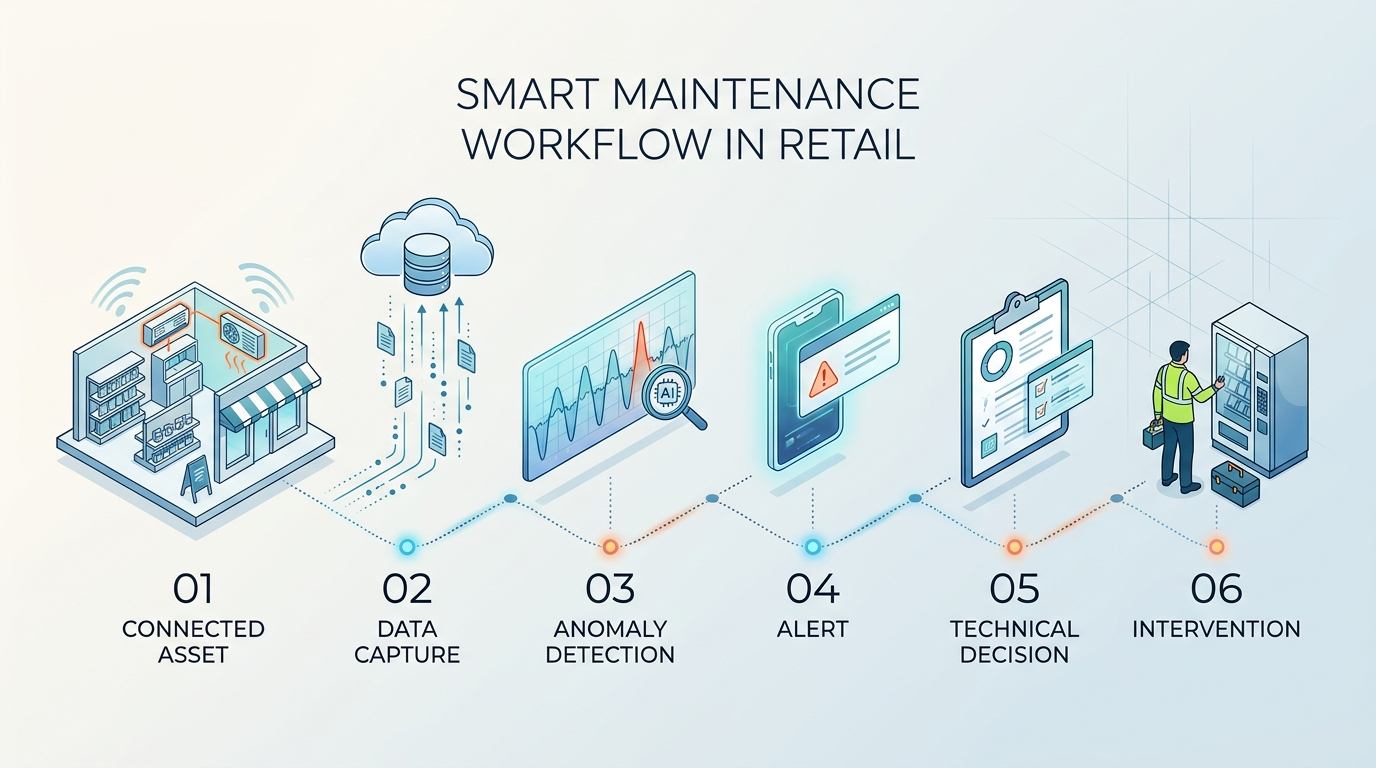
This changes the workflow:
- equipment or systems generate data about their performance;
- the data is centralised and compared against expected parameters;
- an anomaly generates an alert or need for inspection;
- its criticality is assessed and the intervention is prioritised;
- the technician acts with prior information about the problem;
- the intervention and its outcome are recorded for future analysis.
Automation connects diagnosis with operations. That connection is what turns data into a maintenance tool rather than simply stored information.
Predictive maintenance in retail changes when you intervene
A fault in an industrial facility may stop a machine. In retail, a fault can have an immediate impact on customers and sales: an HVAC system that stops working, a blocked automatic door or an electrical issue can affect the store from the moment it occurs. The value of predicting an incident lies in being able to intervene while there is still a choice about when the work takes place.
The predictive maintenance for stores we provide at Optima Retail uses information about equipment behaviour to identify deviations and signs of deterioration. Depending on the installation, variables such as temperature, energy consumption, pressure, vibration, operating cycles or performance levels can be analysed.
The aim is not to replace all preventive maintenance with algorithms. Predictive, preventive and corrective maintenance each serve different purposes and work best as part of an integrated strategy.
| Type of maintenance | What triggers it | Main objective |
|---|---|---|
| Corrective | A fault or incident that has already occurred | Restore operations as quickly as possible |
| Preventive | A predefined schedule or frequency | Reduce the likelihood of failure |
| Predictive | Asset behaviour and performance data | Detect a potential anomaly before failure occurs |
A mature retail network requires all three levels. Automation makes it possible to determine which type of action is appropriate in each situation and coordinate it without losing traceability.
Remote maintenance: resolving issues without always sending a technician
Another direct consequence of digitalisation is the growth of remote maintenance. When systems allow remote supervision, diagnosis or certain adjustments, an incident no longer automatically requires an on-site visit.
This does not mean that every problem can be resolved remotely. A leak, a mechanical breakage or certain electrical interventions will still require a technician to be physically present. The difference lies in being able to assess what is happening first and avoid unnecessary visits or better prepare those that are genuinely required.
Remote maintenance also adds value when an incident ultimately requires an on-site intervention. If the technician receives information about the equipment, its history and the symptoms detected beforehand, they arrive at the store with greater context and less uncertainty.
For international retail networks, this capability becomes even more relevant. At Optima Retail, we operate in more than 50 countries with coordinated management, so having shared visibility across distributed locations helps maintain consistent operational criteria regardless of where each store is located.
Which maintenance processes can be automated?
Not every process has the same automation potential. The best place to start is with repetitive, rule-based tasks that create a significant administrative workload. These are also the areas where human error or lack of follow-up tends to create the most friction.
Incident logging, classification and assignment
A platform can collect requests, classify them by store, asset, category or priority and direct them to the appropriate team. Automation removes much of the intermediary work between detecting a problem and starting to resolve it.
Rather than having to reconstruct what happened afterwards through phone calls and emails, the incident retains a complete history from opening to closure. For operations and Facility Management teams, this improves both day-to-day monitoring and subsequent analysis.
Preventive maintenance scheduling
Recurring inspections can be linked to equipment, stores, dates or specific requirements. The system can anticipate upcoming deadlines and generate actions before someone has to check a calendar manually.
This approach also makes heterogeneous networks easier to manage. Two stores may belong to the same retail chain while having different equipment, ages or technical requirements. Automation does not mean applying the same schedule everywhere; it means systematically managing different maintenance plans within a shared framework.
Alerts based on operational data
When an asset is monitored, certain patterns of behaviour can generate an alert. Consumption outside the expected range, an abnormal temperature or a gradual loss of performance may indicate that the equipment should be inspected. The incident then originates from data rather than from a complaint once the fault has already become visible.
This represents one of the most significant steps towards smart maintenance: turning technical signals into operational decisions.
Monitoring and reporting
A store network generates a considerable amount of maintenance data. Without a shared system, turning it into useful information requires substantial manual effort. Automatically consolidating costs, response times, fault categories and recurring issues makes it possible to identify patterns that an isolated incident would never reveal.
For example, it may become apparent that a particular equipment model accounts for a disproportionate number of faults, that one store generates an unusually high number of incidents or that a particular asset is beginning to require more repairs than can reasonably be justified. This is where maintenance software stops being simply an administrative tool and starts supporting investment decisions.
What changes for the Facility Management team?
Automation does not remove the role of the maintenance or Facility Management professional. It changes where they add value. The fewer hours spent chasing information, the more capacity there is to analyse costs, risks, suppliers and asset performance.
In a manual model, a significant part of the workload involves asking whether a technician has arrived, finding a quotation, checking whether an incident has been closed or gathering information for a report. In a digitalised model, much of that data is already available.
This allows managers to move from handling individual incidents to managing the performance of the entire network. The questions themselves begin to change:
- which assets generate the most incidents?
- which locations account for the highest costs?
- which problems recur after a repair?
- when is it more cost-effective to replace equipment rather than continue repairing it?
- which interventions can be grouped or planned more efficiently?
- which installations show early signs of deterioration?
This change in perspective is one of the greatest benefits of automation. Management is no longer dominated by the next urgent problem and gains the capacity to prevent the next ten.
Software alone does not automate a retail operation
There is a common mistake when digitalising maintenance: assuming that implementing a platform will automatically solve management problems. A tool can only automate a process effectively if that process has already been properly defined.
It is necessary to determine which assets are being managed, which data is relevant, how priorities are classified, when an alert requires intervention, who should act and how closure is validated. Without those criteria, technology can simply end up digitalising the same disorder that already existed.
It is also important to connect the digital environment with the ability to execute. Detecting an anomaly has no operational value if there is no process capable of resolving it afterwards. For this reason, in retail chains with multiple locations, automation and the technical service network need to develop in coordination.
Within our Facility Management model, we combine a management platform, intervention monitoring and technical coordination. This ensures that information does not simply end up on a dashboard: every signal must be capable of becoming a specific action when the situation requires it.
How to know whether a retail chain is ready to automate its maintenance
There is no need to begin by monitoring every piece of equipment in every store. In fact, introducing automation progressively often makes it possible to achieve results sooner and understand which processes deliver the greatest return.
An initial phase can focus on centralising incidents, asset inventories, preventive maintenance and historical data. Integrations, remote monitoring and predictive maintenance can then be introduced for systems whose criticality justifies the investment.
Several signs indicate that an organisation should consider taking this step:
- the team spends too much time coordinating suppliers;
- it is difficult to know the real status of every incident;
- data is scattered across spreadsheets, emails and different systems;
- the same faults occur repeatedly;
- there is limited visibility of costs by store or asset type;
- the network is growing faster than the team responsible for managing it;
- too many decisions continue to be made only after a problem has occurred.
When several of these symptoms are present, the problem is usually no longer limited to technical maintenance, but extends to the way maintenance itself is being managed.
What to measure to determine whether automation is working
Digitalising for its own sake delivers little value. A project should improve operational indicators that can be compared before and after implementation. Technology makes sense when it reduces friction, time, cost or risk in a measurable way.
Some of the most useful indicators include average response time, resolution time, the percentage of recurring incidents, the number of interventions per asset, costs per store and the availability of critical equipment.
In more advanced models, additional metrics may include alerts detected before failure, interventions avoided, incidents resolved through remote diagnosis or corrected energy deviations. Maintenance maturity is better measured by what a system enables you to prevent than by the number of tickets it can process.
Why automation will become increasingly important in retail
Retail networks need to operate increasingly connected facilities while facing constant pressure on costs, energy consumption and service continuity. At the same time, managing large numbers of stores through manual processes is difficult to scale. Automation addresses this tension by increasing control without proportionally increasing the administrative workload.
The next step will be to integrate asset, energy consumption, maintenance and operational data more effectively. This will make it possible to identify relationships that can currently go unnoticed, from rising energy consumption that indicates deterioration to recurring fault patterns across stores with similar characteristics.
Not every store requires the same level of sensorisation, nor does every asset justify predictive maintenance. The future is not about automating absolutely everything, but about deciding precisely which processes are worth automating and retaining human intervention where technical judgement adds value.
For retail chains, the greatest benefit comes when this evolution is approached as part of Facility Management rather than as an isolated technology project. At Optima Retail, we centralise preventive, predictive and corrective maintenance together with intervention coordination so that technology ultimately translates into fewer incidents, better information and greater store continuity.
The question, therefore, is no longer whether retail maintenance will become more automated. The relevant decision is which part of your operation you can stop managing manually today.