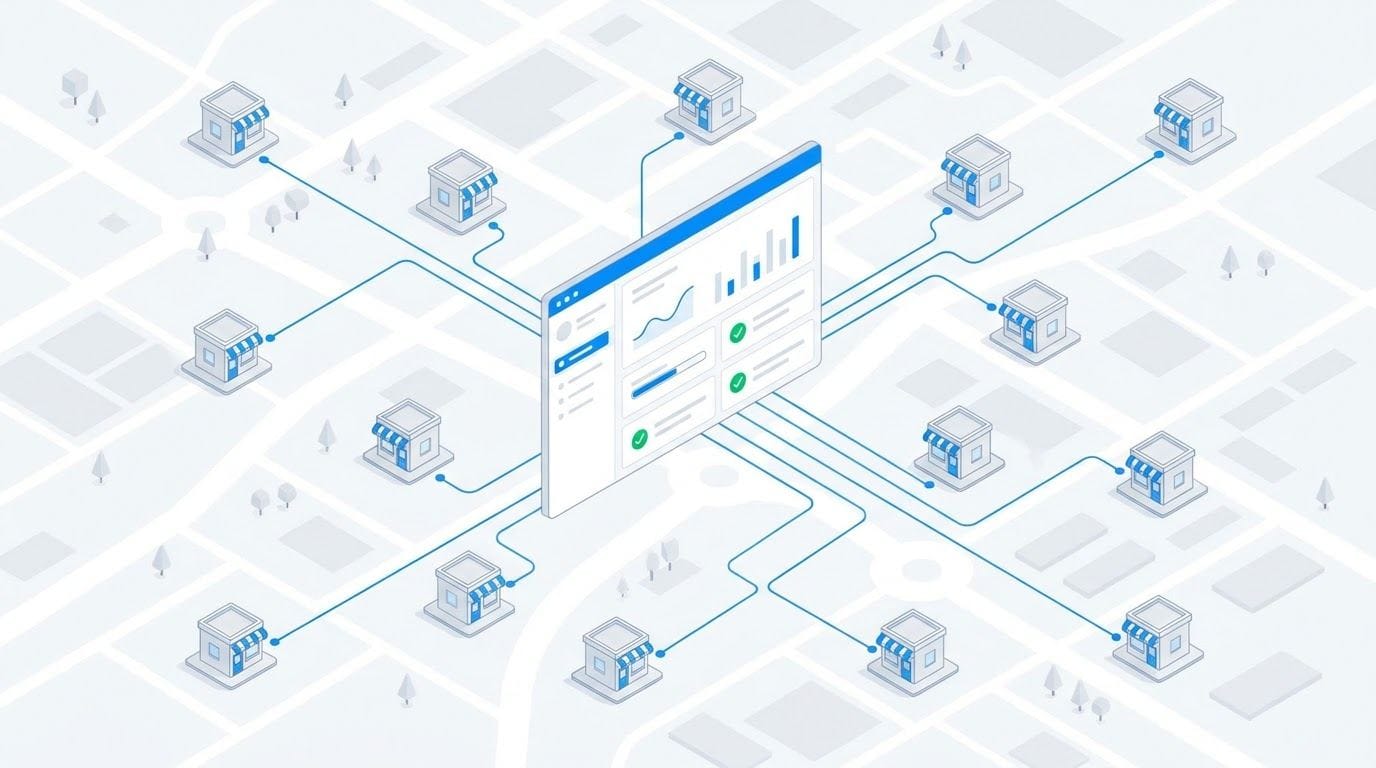
When a chain grows from five stores to forty, maintenance stops being a list of checks and becomes a coordination problem. Every site has its own air conditioning, automatic doors, electrical installation and fire extinguishers, each with its own legal deadlines, and all of it has to fit around a trading calendar that leaves no room for error: a breakdown in the middle of the Christmas peak costs far more than the repair itself. An annual planned preventative maintenance (PPM) plan is the tool that brings order to that chaos. Here we explain why a retail chain needs one and how to structure it step by step, with reference frequencies and a schedule built around retail’s busiest trading periods.
What an annual planned preventative maintenance plan is (and how it differs from a schedule)
A preventative maintenance plan is the document that sets out what gets checked, how often, who does it and with what budget for every installation across the estate. The PPM schedule is just one part of it: the part that turns frequencies into actual dates. If you want a refresher on how to build a basic maintenance schedule, that is a good starting point, but a chain needs a great deal more.
The difference is scale. An independent shop can get by with a spreadsheet and a trusted engineer. A store network needs a common standard applied across every location, clear criteria for deciding what comes first when the budget does not stretch to everything, coordination with shopping centres and landlords, and a system that shows at any moment what has been done and what is outstanding at each site. The annual plan is what turns forty separate maintenance regimes into one.
Why a store chain needs an annual plan rather than one-off checks
The alternative to a plan is what we often find when a chain first starts working with us: each store handles its own checks as best it can, contracts are spread across several local suppliers and nobody has the full picture. The outcome is predictable. Statutory inspections pile up or get missed, breakdowns cluster in the months of heaviest use and reactive maintenance ends up eating the budget that should have gone on prevention. If you are unsure where the balance lies, we look at it in detail in our comparison of preventive and corrective maintenance in retail.
A well-structured annual plan solves four problems at once:
- Compliance: statutory fire safety, electrical and HVAC inspections are scheduled and documented in every store, not just the ones with a particularly diligent manager.
- Uninterrupted trading: work is concentrated in the quietest months and time slots, well away from the sales, Black Friday and Christmas.
- Predictable budget: spend is spread across the year and no longer depends on breakdowns.
- Consistent brand image: customers find the same standard in London, Manchester or Madrid, because every store follows the same protocol.
At Optima Retail we sum it up like this: an annual plan does not add work, it organises it. The checks were going to happen anyway; the difference is doing them when it suits the business rather than when something fails.
How to structure an annual PPM plan in 6 steps
There is no single template that works for every chain, because a supermarket network does not face the same risks as a fashion or optician chain. The method, however, is the same. These are the six steps we follow when designing a chain’s maintenance plan.
1. A store-by-store asset register with a common standard
Everything starts with knowing what is in each site. The asset register records every installation and piece of equipment with its location, age, make, model and condition: HVAC units, distribution boards, lighting, automatic doors, roller shutters, fire safety systems, plumbing, roofs, technical fixtures and cold rooms where there are any.
In a chain, the key is that every store uses the same record format. If one store logs “air conditioning” and another records “14 kW heat pump installed in 2019”, the data cannot be compared or aggregated. A consistent register is what later lets you spot, for example, that units from one manufacturer fail more often in coastal stores, or that stores opened before a certain year account for most electrical faults. If you are preparing new openings, the record should be part of your new store opening checklist from day one.
2. Rank installations by criticality
Not every asset deserves the same attention. The most practical way to prioritise is a three-tier ranking based on the impact a failure would have on sales, safety and legal compliance:
- Criticality A: failure forces the store to close or creates a legal or safety risk. Fire safety systems, main distribution board, main entrance door, refrigeration in food retail.
- Criticality B: failure degrades the customer experience or operations, but the store can stay open. HVAC, shop floor lighting, roller shutters, toilets.
- Criticality C: failure has a cosmetic or minor impact. Secondary signage, paintwork, small fixtures and fittings.
This ranking decides two things: how often each asset is checked and the order of priority when the budget or available engineers cannot cover everything. A Criticality A asset should never miss its scheduled visit; a Criticality C asset can be grouped with other visits to save on travel.
3. Set frequencies: compliance as the backbone
Frequencies come from three sources, in this order: what the law requires, what the manufacturer recommends and what actual use dictates in each store. Legislation sets the non-negotiable minimum; manufacturer guidance and breakdown history fine-tune the rest. A high-footfall store will need its automatic doors serviced more often than a quiet one, even if they have exactly the same model fitted.
The table below summarises the most common reference frequencies for retail premises in the UK. It is a guide only: each installation may carry additional requirements depending on its capacity, floor area or activity.
| Installation | Reference frequency | Regulatory framework |
|---|---|---|
| Fire alarms and detection | Weekly test by the responsible person; servicing by a competent engineer at least every 6 months | Regulatory Reform (Fire Safety) Order 2005, BS 5839-1 |
| Fire extinguishers and emergency lighting | Monthly visual checks and emergency lighting flick test; annual extinguisher service and full-duration emergency lighting test | BS 5306-3, BS 5266-1 |
| Fixed electrical installation | Annual preventative check of distribution boards (thermal imaging recommended) and an Electrical Installation Condition Report (EICR) every 5 years for shops | Electricity at Work Regulations 1989, BS 7671 |
| HVAC and ventilation | Filter cleaning or replacement monthly or quarterly depending on use; servicing before each season; F-gas leak checks based on system size; TM44 inspection every 5 years for systems over 12 kW | F-gas Regulations, Energy Performance of Buildings Regulations |
| Water systems | Legionella risk assessment kept under review; monthly temperature checks on outlets | HSE ACOP L8 |
| Automatic doors | Quarterly or six-monthly depending on footfall, including checks on sensors and safety devices | BS EN 16005 and manufacturer’s instructions |
| Pest control | Based on risk assessment; regular routine visits throughout the year are standard in food retail | Food hygiene legislation and pest control contract |
| Roller shutters, locks, roofs and façade | Six-monthly or annual, plus gutter and roof checks before the autumn storms | Best practice and manufacturer’s guidance |
Two of these lines deserve special attention, because they account for a large share of the enforcement notices and closures we see in the sector. Fire safety comes with its own deadlines and responsibilities, and is one of the areas we cover through our fire protection maintenance service. Automatic doors, given how heavily they are used, are among the assets that break down most often in high street stores; you will find the detail in our article on automatic door maintenance in retail.
If your chain operates in more than one country, the backbone changes in each one. Every market has its own regulations and its own deadlines, and the plan has to reflect that store by store. We cover this in depth in our article on compliance across multiple countries.
4. Build the PPM schedule around the trading calendar
This is the step most often overlooked and the one that makes the biggest difference in retail. A technically perfect plan fails if it books the HVAC service the week before the sales or replaces a distribution board in the middle of December. The maintenance schedule has to be built on top of the trading calendar, not the other way round.
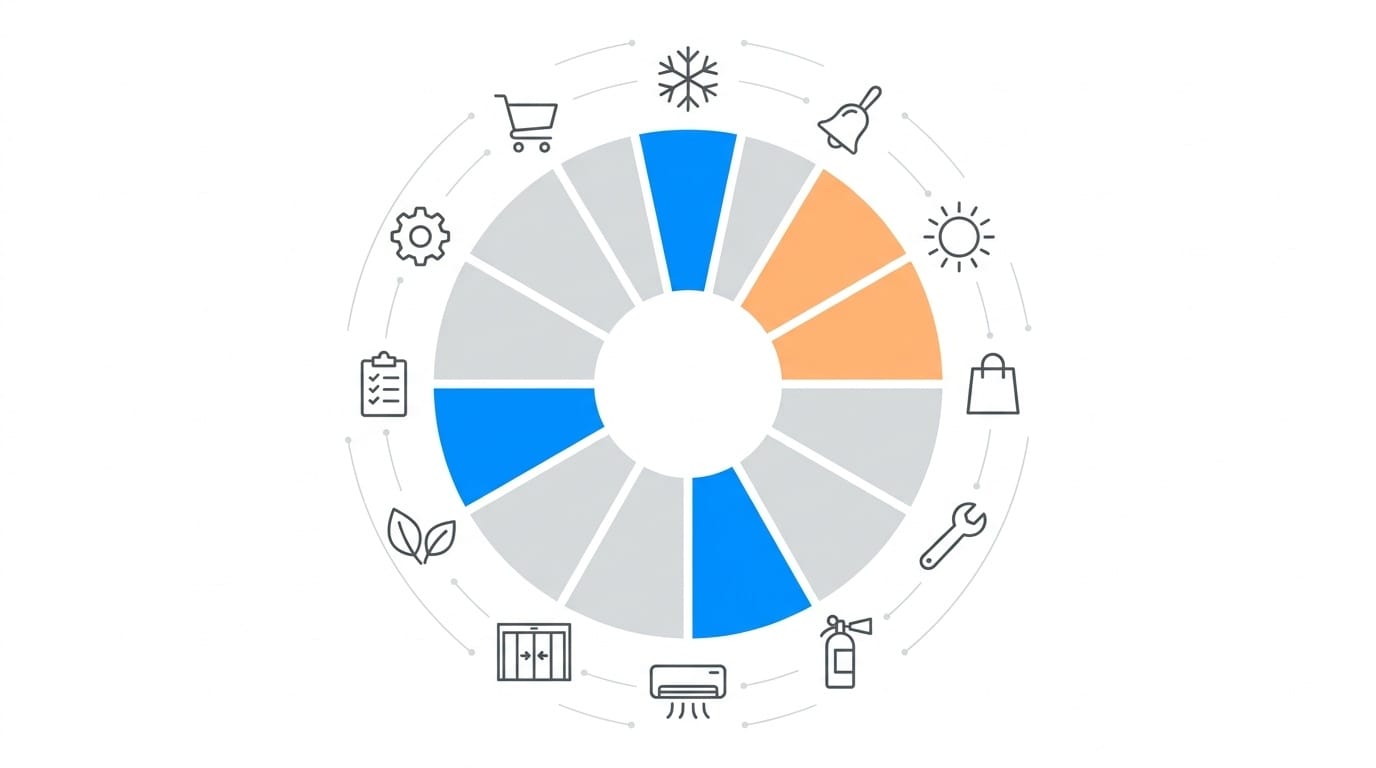
The logic is simple: major works go into the quiet months, servicing is brought forward ahead of each peak in demand and the busiest trading periods are kept for emergencies only. This is how the year breaks down for a fashion or homeware chain in the UK:
| Period | Trading context | What to schedule |
|---|---|---|
| February and March | Quiet period after the January sales | Larger jobs: electrical testing, minor refurbishments, redecoration, replacing equipment at the end of its service life |
| April and May | Before the warm weather and the summer season | Air conditioning servicing in cooling mode, roof and awning checks, stepped-up pest control |
| June and July | Summer sales and peak air conditioning use | Light maintenance outside trading hours and emergency response only |
| August and September | Back to school and new season collections | Heating servicing, doors and shutters, gutters and roofs ahead of autumn; refurbishments in lower-footfall stores |
| October | Last window before golden quarter | Full review of Criticality A assets in every store, shop window lighting, closing out any outstanding actions |
| November to January | Black Friday, Christmas, Boxing Day and the January sales | Freeze on planned works; only statutory checks falling due and emergencies |
This framework needs adapting to each type of business: a toy chain peaks in December, a stationery chain in August and September, and a grocery chain has barely any quiet periods at all. What matters is that every planned job has a window that works around trading. Two points in the year account for much of the preventative workload, and we have dedicated articles to both: how to prepare store maintenance for the summer sales and peak season, and the essential maintenance before autumn.
Within each window, you also need to choose the time slot. With the chains we work with, we schedule visits before opening or after closing whenever the job allows, and in shopping centres we coordinate with the centre’s facilities team to respect their access and delivery times. The store should not notice the engineer has been, other than the fact that everything works.
5. An annual budget by store and by service line
Once the asset register, frequencies and schedule are agreed, the budget practically calculates itself. We recommend structuring it as a matrix of stores against service lines (HVAC, electrical, fire safety, doors, pest control, minor works), so it can be read both by site and by trade.
It is also wise to ring-fence a budget line for reactive work. No preventative plan eliminates every breakdown, and it is better to accept that from the outset than to reallocate funds halfway through the year. What a good plan does achieve is that this line shrinks from one year to the next as the preventative programme matures. If you want to get a tighter grip on the energy costs tied to your installations, an energy audit of your premises helps you decide which equipment is worth replacing rather than continuing to maintain.
6. KPIs and a quarterly plan review
An annual plan is not something you write in January and file away. It needs indicators that show whether it is working and a regular review to correct course. These are the KPIs we recommend tracking across a store network:
- PPM compliance: the percentage of planned maintenance tasks completed against those scheduled, by store and by service line.
- Planned vs reactive ratio: how much of your spend and workload is planned and how much is responding to breakdowns.
- Repeat faults: breakdowns that recur on the same asset or in the same store, a sign that the frequency or the fix is not right.
- Average time to resolution: from the moment a fault is reported to the moment it is fixed.
- Maintenance cost per store or per square metre: to compare sites and spot the ones that stand out.
Reviewing this data every quarter lets you make informed decisions: increasing the frequency in stores with more breakdowns, reducing it where everything runs smoothly or bringing forward the replacement of a unit. At Optima Retail we centralise everything in Optima Online, our maintenance management software, where clients can see the status of every store in real time, along with visit reports and the fault history for their entire estate.
Common mistakes when planning maintenance across a store network
Plans that do not work tend to fail for the same reasons. The most common is copying the pilot store’s plan across every other site without taking into account that a unit in a climate-controlled shopping centre does not have the same needs as a high street store on the coast. The standard should be common; the frequencies, not necessarily.
The second mistake is planning only for compliance. Keeping fire risk assessments and EICRs up to date is essential, but the breakdowns that hurt sales most are usually elsewhere: the air conditioning that fails in July, the door that sticks open in January or the shutter that will not go up on a Monday morning. A good plan covers both statutory obligations and the assets that are critical to the customer experience.
The third is supplier fragmentation. When each store or each trade has its own contractor, nobody has the full picture, reports arrive in different formats and agreeing a work window turns into a negotiation. That is why many chains choose to bring everything together under a single facilities management provider, a trend we explore in our article on why more chains are outsourcing store maintenance.
In-house plan or a maintenance contract with a specialist provider
A chain can run its annual plan with its own maintenance team, with several suppliers coordinated from head office or with a single provider that takes on the whole plan. The in-house option gives you control, but it demands structure: engineers in every region, knowledge of several sets of regulations and a system to record everything. For most mid-sized networks, the single-provider model proves more efficient, provided the contract is clearly defined.
If you go down that route, these are the points a retail maintenance contract should set out in writing:
- ☑ Asset register and PPM frequencies for each store, attached to the contract.
- ☑ An annual schedule of works aligned with the chain’s trading periods.
- ☑ Committed response times for faults and emergencies, set by criticality.
- ☑ Accredited contractors for statutory inspections, with certificates provided.
- ☑ A report for every visit and access to a central dashboard showing the status of the whole estate.
- ☑ A procedure for carrying out repairs without changing supplier when a visit identifies a fault.
- ☑ Regular review of the KPIs and of the plan itself.
If you are weighing up your options, especially for a network with stores in several countries, our guide on how to choose a maintenance provider for retail chains in Europe may help. For our part, we work with a single point of contact for the whole network, our own technical network, a written response in under 24 hours and a 24/7 emergency service with attendance in under 4 hours, so anything preventative maintenance does not prevent is resolved under the same contract.
The ideal time to design next year’s plan is right now: while this year’s data is still fresh and before peak season leaves no room to think. Start with the asset register and criticality ranking, base your frequencies on the regulations and build the schedule around your trading peaks. If you would rather we did it with you, our preventive maintenance service for retail chains designs the annual plan for your network, delivers it with minimal disruption to store activity and gives you full visibility of every store from the very first month.