When we talk to expansion or operations managers at retail chains, the question is rarely what facility management is. Most of them already know, even if they don’t always call it that. The real question is different: does it still make sense to manage maintenance for each store in-house, or is it time to centralise it with a single provider? That decision, not the definition of the term, is what determines how much time, money and hassle a retail chain saves each year.
What retail facility management actually covers
Retail facility management brings together everything that keeps a store running, safe and on-brand: from preventive and corrective maintenance of installations to air conditioning, electrics, fire protection, pest control, automatic doors and cleaning. It also covers openings, closures and refurbishments, plus an emergency service that responds when something fails outside trading hours.
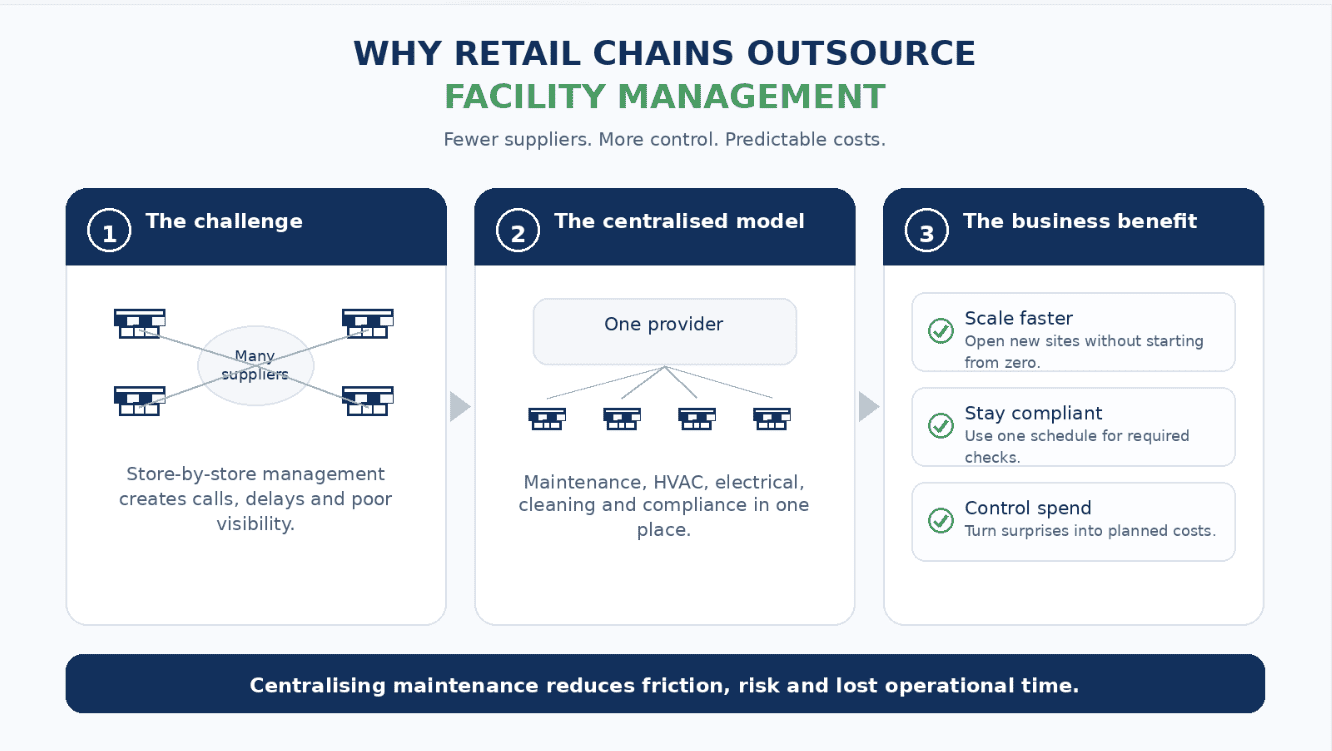
On their own, each of these areas looks manageable. The problem appears once you multiply them across a chain’s stores: ten outlets can mean ten different air conditioning contractors, ten electricians and ten separate points of contact for every emergency. Bringing these areas together under a single contract is exactly what changes the equation for anyone managing maintenance across a store network.
Why retail chains are outsourcing maintenance
The reason that comes up most often — “saving money” — is real, but incomplete. The savings don’t only come from negotiating better rates; they come from removing the friction of coordinating different providers in every city. We’ve seen chains juggling three or four different technical contacts per store, spending more hours managing calls and scattered invoices than actually resolving issues.
There are at least three underlying reasons behind this trend:
- Geographic scalability. Opening a new store, in another city or another country, no longer means sourcing and vetting local providers from scratch.
- Regulatory compliance. Every type of installation (fire safety, electrics, air conditioning) has its own mandatory inspection cycle, and tracking that manually across 20 or 200 stores is a compliance risk, not just an administrative task.
- Cost predictability. A centralised maintenance plan turns a reactive, unpredictable cost into a plannable annual budget line.
None of these three reasons depends on the size of the chain. The scale changes, but the logic is the same for a brand with 8 stores as for one with 200.
In-house team or outsourcing: what changes in practice
Building an in-house maintenance team makes sense when a chain operates in a single city or region, with few outlets and homogeneous technical needs. In that scenario, hiring your own electricians, air conditioning technicians or cleaning staff can pay off.
The calculation changes as soon as geographic spread and variety of installations come into play. An in-house team has to cover demand peaks (sales periods, openings, night-time emergencies) with a workforce sized for day-to-day operations, which almost always means overspending in high season or lacking cover exactly when it’s needed most. Outsourcing shifts that risk to a provider who spreads that capacity across several clients — something an in-house structure can’t replicate without hiring staff who’ll sit underused for most of the year.
Signs it’s time to centralise maintenance
There’s no magic number of stores at which outsourcing starts to make sense, but there are clear signs the current model has run out of road:
- Every breakdown means locating and coordinating a different provider depending on the city or type of issue.
- No one in the organisation has centralised visibility of the maintenance status across all stores.
- Regulatory inspections (fire safety, electrics, air conditioning) are managed store by store, with no single calendar.
- Maintenance spend swings wildly month to month and is hard to forecast in the annual budget.
- Every opening or refurbishment means sourcing local providers all over again.
If two or more of these sound familiar, the cost of not centralising is probably already higher than the cost of doing it, even if it never shows up as a visible line in any financial report.
What a retail facility management provider must guarantee
Outsourcing only works if the provider solves exactly the problem that prompted the change in the first place. Three things are worth insisting on before signing anything:
- A single point of contact for every store, with no reliance on local subcontractors the chain still has to coordinate itself.
- Digital traceability of every intervention: what was done, when, at which store and at what cost, accessible in real time.
- Genuine coverage wherever the chain operates, including emergency response outside trading hours.
At Optima Retail, for example, every visit and incident is logged on our own digital platform, backed by a quality control department certified by Bureau Veritas, with a presence in more than 50 countries. We mention this not as a sales pitch, but because it’s exactly the kind of assurance worth asking any provider for before handing over maintenance for an entire store network.
Outsourcing retail facility management isn’t a passing trend: it’s the logical response for chains growing faster than their internal structures can absorb. The question isn’t whether centralising maintenance makes sense, but how much it’s already costing you not to.
Retail maintenance
A single point of contact for the maintenance of all your stores, across Spain and internationally.