Fire protection in retail premises is not simply a matter of installing a few extinguishers and arranging an annual visit. This guide explains what Spanish fire safety regulations require from shops and other retail premises, including extinguishers, fire hose reels, alarms, detection systems, evacuation, maintenance and inspections. The requirements and thresholds below apply specifically to Spain; stores in other countries must be assessed under the legislation in force in their own jurisdiction.
This distinction matters for international retail chains. Fire safety legislation, technical standards, inspection regimes and maintenance requirements vary from country to country. At Optima Retail, we adapt the management of fire protection systems to the local requirements and regulations applicable in each market, while maintaining a consistent operational approach across the store network.
Which fire protection regulations apply to retail premises in Spain?
For retail premises in Spain, the main national framework is based on CTE DB-SI and the Fire Protection Installations Regulation, known as RIPCI. The two complement one another, but they regulate different aspects of fire safety.
The Fire Safety Basic Document of the Spanish Technical Building Code, or CTE DB-SI, sets out the fire safety conditions that the building or premises must meet. These include fire spread, evacuation, structural fire resistance, access for the fire and rescue services and the provision of fire protection installations.
RIPCI, approved by Royal Decree 513/2017 and subsequently amended, regulates the design, installation, commissioning, maintenance and inspection of active fire protection equipment and systems. The current framework also incorporates amendments introduced by Royal Decree 164/2025.
Does the RSCIEI apply to an ordinary shop?
The RSCIEI, Spain’s Fire Safety Regulation for Industrial Establishments, is primarily aimed at industrial establishments rather than conventional retail premises. Royal Decree 164/2025 introduced a new version of this regulation and also amended aspects of RIPCI and DB-SI.
It can nevertheless become relevant where a site includes industrial or storage areas falling within its scope or presents configurations that require a separate technical assessment. Correctly classifying the use of each area is therefore essential before deciding which fire protection measures apply.
National legislation is not always the end of the assessment. Regional and local requirements may also affect licences, refurbishment works, inspections or technical documentation, so compliance should always be checked against the actual premises and the competent authority.
What fire protection systems does the Spanish CTE require in retail premises?
Not every shop requires the same fire protection systems. The Spanish CTE establishes different requirements according to floor area, evacuation height and specific fire risks, so a small high-street shop and a large retail unit should not be assessed in the same way.
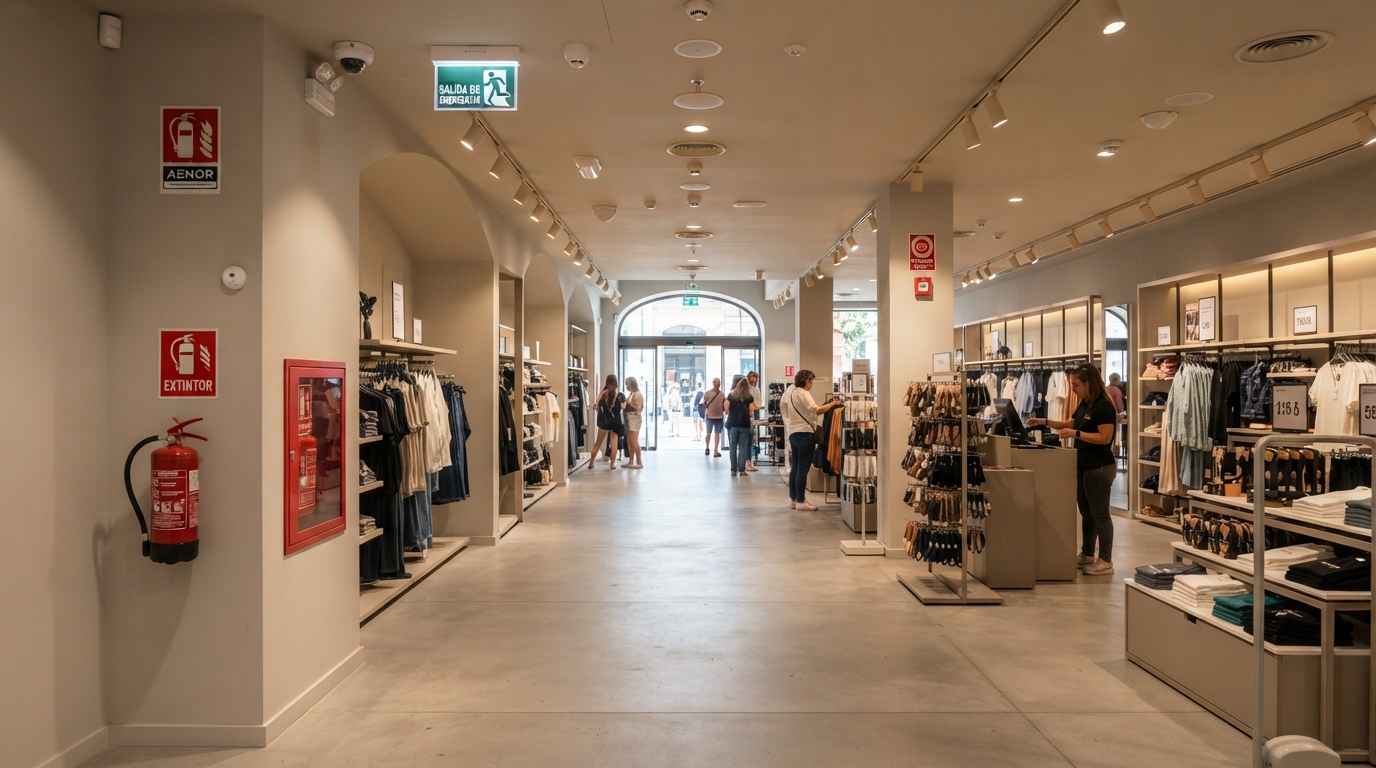
The table below summarises some of the principal requirements established by DB-SI for premises classified as Commercial use. These thresholds are a practical starting point rather than a substitute for a technical assessment, because special-risk rooms, storage areas, the building configuration and other conditions can alter the final specification.
| Equipment or system | General requirement in Spanish Commercial use | What to consider |
|---|---|---|
| Portable fire extinguishers | As a general rule, 21A-113B extinguishers with no more than 15 m travel distance from any evacuation origin on each floor | Special-risk areas may require additional equipment |
| Fire hose reels (BIE) | Required when the constructed floor area exceeds 500 m² | Type, location and coverage must comply with the applicable technical requirements |
| Fire alarm system | Required when the constructed floor area exceeds 1,000 m² | The system must be designed to provide appropriate warning to occupants |
| Fire detection system | Required when the constructed floor area exceeds 2,000 m² | Design and coverage must reflect the protected areas and their risks |
| Dry riser | Required when the evacuation height exceeds 24 m | Particularly relevant to retail premises within taller buildings |
| Automatic fire suppression | Required where the public sales area exceeds 1,500 m² and the weighted and corrected fire load density contributed by the products exceeds 500 MJ/m² | The protected area and associated medium- and high-risk rooms must be assessed |
| External fire hydrants | One where the total constructed floor area is between 1,000 and 10,000 m², plus one for every additional 10,000 m² or part thereof | Existing public hydrants and the site configuration must be considered in the technical design |
A 300 m² shop and a large retail unit therefore start from very different requirements. Floor area is important, but it is not the only factor: layout, number of floors, evacuation routes, stockrooms, technical rooms and the materials or products present can all affect the final solution.
At Optima Retail, our fire protection maintenance service takes this broader view into account, covering systems such as extinguishers, detection and alarm equipment, fire hose reels, sprinklers, fire doors, signage, maintenance and associated documentation. The aim is to keep the protection installed at each site aligned with the premises and the applicable regulations.
Evacuation and passive fire protection are part of the same system
A shop may have correctly maintained extinguishers and still present significant fire safety shortcomings. Fire protection also depends on occupants being able to leave the premises safely and on fire and smoke being contained for long enough to support evacuation.
DB-SI therefore considers escape routes, exits, fire compartmentation, construction elements and access for the fire and rescue services alongside active systems. Active and passive fire protection must work together, particularly in retail environments where layouts can change several times during the life of a store.
Escape routes and exits
The number of exits and the permitted travel distances depend on occupancy and the configuration of the premises. A layout with a single valid exit is generally subject to more restrictive conditions than one with suitable alternative means of escape.
Shelving, promotional displays, tills, fitting rooms or seasonal installations can alter a previously compliant layout. An escape route has to remain usable during the store’s real day-to-day operation, not merely on the drawings produced when the premises first opened.
Fire doors, service penetrations and compartmentation
Fire-resisting doors and other compartmentation elements are intended to limit the movement of fire and smoke between areas. A wedged-open fire door, a defective closer or an inadequately sealed penetration can undermine that protection.
Refurbishment work deserves particular attention because electrical, HVAC, telecommunications and pipework installations may pass through fire-resisting construction. Any intervention should preserve the integrity of the original fire compartmentation. Store entrances and doors also need to be considered as part of the wider maintenance strategy; our guide to automatic door maintenance in retail examines the operational and regulatory considerations affecting these assets.
Signage, emergency lighting and visibility
Manual fire-fighting equipment needs to be visible and accessible. An extinguisher hidden behind stock or promotional material is far less useful when an incident occurs, and the same applies to escape signs that can no longer be seen after a layout change.
Operational inspections should therefore consider the equipment and its surroundings. Checking a maintenance date alone is not enough: accessibility, signage, obstructions and consistency between the physical store and its technical documentation also matter.
Fire protection maintenance in Spain: what is checked and how often?
RIPCI sets minimum maintenance programmes for active fire protection systems. There is no single annual interval that applies to every item of equipment; the regulation includes quarterly, six-monthly, annual and five-year maintenance operations, depending on the system.
Fire extinguishers, for example, are subject to periodic checks during the year, annual maintenance requirements and five-year pressure-related testing under the applicable programme. Fire detection, alarm, fire hose reel and automatic suppression systems have their own inspection and maintenance tasks.
The regulation also distinguishes between operations that may, under the specified conditions, be carried out by the user or system owner and those that must be performed by specialist personnel from the manufacturer or an authorised maintenance company. Compliance therefore depends on both the frequency of the work and who is permitted to carry it out.
This is why we treat fire protection as part of planned maintenance rather than waiting for an equipment failure or an inspection date. In our guide comparing preventive and corrective maintenance in retail, we examine how planned interventions change operational risk and expenditure. With fire protection, preventive maintenance also supports regulatory compliance.
Maintenance and statutory inspections are not the same thing
A common mistake is to assume that having a maintenance contract means every inspection obligation has been fulfilled. Routine maintenance and statutory inspection are separate controls: one is designed to preserve the condition and operation of the systems, while the other assesses regulatory compliance where a formal inspection regime applies.
Under Article 22 of RIPCI, where inspection is not governed by other specific regulations, fire protection installations must generally be inspected at least every ten years by an accredited control body. There are exemptions, including certain Commercial-use premises with a constructed floor area below 500 m², provided that the additional conditions set out in the regulation are met.
This does not mean that a small shop falling within that particular inspection exemption has no fire protection obligations. The exemption does not remove the applicable maintenance requirements, nor does it override other obligations arising from the premises, its risk areas or another applicable regulation.
Documentation is also part of compliance
Maintenance certificates, inspection records, equipment inventories, test results and commissioning documentation provide evidence of what has been carried out and when. RIPCI requires records demonstrating preventive maintenance compliance to be retained for at least five years.
For a retail chain, centralising this information reduces the need to search store by store when an audit, inspection or incident occurs. Traceability becomes particularly valuable in multi-site retail, where equipment, inspection dates and corrective actions can vary significantly between locations.
What changes when a retail unit is refurbished or its layout changes?
Fire protection should not be treated as a system that remains unchanged from opening day. A refurbishment can alter the conditions on which the original fire safety solution was based, even when the commercial activity itself remains the same.
Changes to occupancy, escape routes, compartmentation, ceilings, technical rooms, storage areas or the location of equipment should therefore be reviewed from a fire safety perspective. A new layout can create a compliance issue without any individual fire protection device actually failing.
This is particularly relevant when adding stockrooms, closing former routes, relocating electrical equipment or creating new service penetrations. Our guide to dealing with an electrical fault in retail premises also illustrates why electrical maintenance and fire risk cannot be treated as entirely separate subjects. The technical systems within a shop interact with one another.
Common mistakes that can compromise fire protection in a shop
Many fire safety problems do not arise because protection is completely absent. They develop because small operational changes gradually move the premises away from the condition originally assessed. Fast-moving retail environments are particularly vulnerable to this type of drift.
Before opening, refurbishment or a scheduled review, it is worth looking at the shop from an operational as well as a technical perspective. A structured visual check can reveal issues that should then be assessed by the appropriate specialist.
- Fire extinguishers hidden by shelving, stock or promotional displays.
- Fire doors held open or fitted with defective closing mechanisms.
- Signs that are damaged, obscured or no longer positioned correctly.
- Escape routes altered after a change in store layout.
- Maintenance dates that are not coordinated with the regulatory programme.
- New service penetrations through fire-resisting elements without suitable fire stopping.
- Incomplete or dispersed documentation that no longer matches the equipment on site.
The purpose of this type of check is not to replace a formal technical inspection. It helps prevent day-to-day retail activity from undermining measures that were correctly designed and installed. Stores that regularly change displays, fixtures or internal layouts should build these checks into their maintenance routines.
Spanish fire regulations should not be applied to stores in other countries
The thresholds set out in this guide are specific to Spain. A store in the United Kingdom, France, Italy, Portugal or another country must be assessed under the legal and technical framework that applies there. Requirements relating to risk assessments, equipment, inspection bodies, maintenance intervals, documentation and responsible parties can differ substantially.
For an international chain, the challenge is therefore to combine consistent management with local compliance. The operating standard can be centralised, but regulatory requirements must remain country-specific. Applying a Spanish 500 m², 1,000 m² or 2,000 m² threshold automatically to a store elsewhere would not be an appropriate compliance strategy.
At Optima Retail, we work across international retail networks and adapt our maintenance coordination to the local schedules, requirements and regulations of each location. Through our international retail maintenance coverage, we can maintain a single management approach while coordinating the local technical requirements that apply to each country.
This model is particularly useful for facilities and expansion teams managing stores across several markets. The objective is not to make every country’s legislation identical, but to make compliance easier to control across the network, with clearer responsibilities, records and follow-up for each location.
How to prepare retail premises for a fire protection review
The most effective way to approach a fire protection review is not to treat it as a one-off event. Compliance depends on maintenance, traceability and control over changes made to the premises throughout the store’s operating life.
A useful pre-review should compare the equipment actually installed with the current layout and the available technical documentation. If those three elements no longer match, the discrepancy deserves attention before the review is considered complete.
- Confirm the current use, floor area and layout of the premises.
- Check whether the installed fire protection systems match the characteristics of the site.
- Verify that equipment remains accessible and correctly identified.
- Review maintenance dates, certificates and outstanding actions.
- Check fire doors and other passive fire protection elements.
- Review escape routes after any change to the store layout.
- Organise maintenance certificates and applicable statutory inspection reports.
For multi-site retailers, the difficult part is often maintaining the same level of visibility across the whole estate. Centralising equipment records, inspections, maintenance and corrective actions reduces gaps between individual stores while still allowing each location to follow its own applicable legislation.
Frequently asked questions about fire protection regulations in Spanish retail premises
Regulatory thresholds can be confusing because an obligation applying to a large retail unit may not apply to a smaller shop. The correct answer always depends on the characteristics and classification of the premises, together with any additional requirements imposed by the activity or location.
The following answers address some of the most common practical questions. Refurbishments, mixed-use premises, unusual storage conditions or special-risk areas should always be assessed individually before selecting or modifying a fire protection system.
Does every shop in Spain require a fire hose reel?
No. Under the general CTE DB-SI requirement for Commercial use, fire hose reels are required when the constructed floor area exceeds 500 m². Other site-specific conditions may nevertheless need to be considered.
Does every retail unit require automatic fire detection?
No. For Commercial use, DB-SI generally requires a fire detection system when the constructed floor area exceeds 2,000 m². The fire alarm system has a separate general threshold of more than 1,000 m².
Are fire extinguishers inspected only once a year?
No. The Spanish maintenance programme contains operations at different intervals, and annual maintenance is only one part of that programme. The applicable tasks depend on the type of equipment and the requirements established by RIPCI and the relevant technical standards.
Does refurbishing a shop mean its fire protection needs to be reviewed?
The scope of the refurbishment must be assessed. Changes affecting occupancy, escape routes, compartmentation or fire protection installations can alter the fire safety conditions of the premises. A seemingly simple layout change can therefore have consequences beyond interior design.
Does a shop below 500 m² have no fire protection obligations?
No. The exemption for certain periodic RIPCI inspections below that threshold does not eliminate maintenance or the other fire safety requirements that apply. Floor area, layout, risk areas, use and any other applicable rules still need to be considered.
Fire protection should evolve with the store
Spanish fire safety regulations should not be reviewed only when a shop first opens. Retail premises change through refurbishments, new equipment, merchandising, storage and operational decisions, and their fire protection arrangements need to remain consistent with those changes.
At Optima Retail, we integrate fire protection into the wider management of retail facilities and adapt the service to the legislation applicable in each country. For international retail networks, this means combining local regulatory compliance with centralised maintenance visibility, so that equipment, inspections, corrective actions and documentation can be managed with greater consistency across the estate.