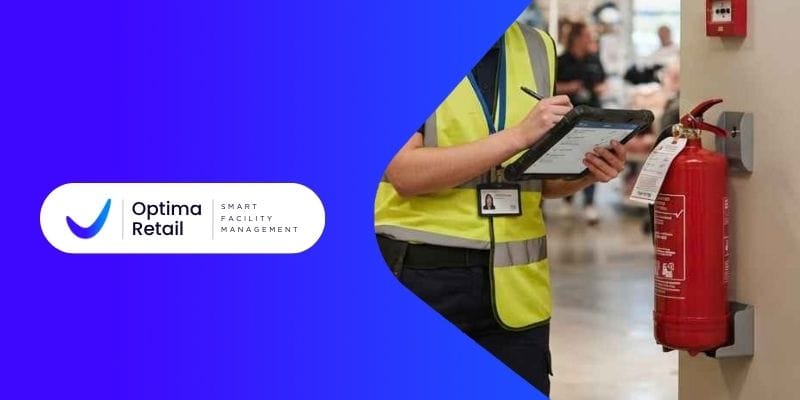

Opening a new store is a race against the calendar: fit-out, furniture, stock, staff and the launch campaign all converge on the same date. Under that pressure, the technical installations are usually the last thing to be checked and the first thing to fail. An undersized electrical panel, a badly adjusted automatic door or a fire extinguisher without its certificate can delay the opening or ruin the first day of trading.
This facility management checklist for a new store opening brings together everything a retail chain or franchise network should verify before day one: technical systems, mandatory documentation, the inspection schedule and the handover to ongoing maintenance. It is written for expansion, operations and maintenance managers who open several stores a year and need a repeatable standard.
What is a facility management checklist for a new store opening?
A facility management checklist for a new store opening is the structured list of technical, regulatory and operational checks that confirms a commercial unit is ready to open to the public safely and without incidents. It covers the installations (electrics, HVAC, fire protection, plumbing and access), the legal documentation and the start-up of maintenance.
It differs from an operational store checklist (tills, stock, staff) in that its focus is the premises and their installations. Both are needed, but failures in the first are more expensive: they usually require technicians, parts or certificates that cannot be obtained in 24 hours.
When to start: the inspection schedule before day one
The technical review of a store opening starts six to eight weeks before the planned date, not the week before. That margin allows you to correct defects from the fit-out, process certificates and repeat tests without moving the launch.
| Timing | What to check | Expected outcome |
|---|---|---|
| 8 to 6 weeks before | Technical audit of the unit: condition of existing installations, contracted power supply, drawings and refurbishment project | List of defects and corrective plan |
| 6 to 4 weeks before | Supervision of the new installations: electrical panel, HVAC, fire protection and plumbing | Installations carried out as specified |
| 4 to 2 weeks before | Functional testing, equipment commissioning and certificate applications | Equipment tested and documentation in progress |
| 2 to 1 week before | Final inspection, post-construction cleaning and preventive pest control | Unit handed over and documented |
| Day 0 and day 1 | Walkthrough with the store manager and a reachable technician on call | Opening with no critical incidents |
If the store is opening in a shopping centre, align this schedule with the centre’s technical rules, which usually set their own handover dates and inspections. We explain this in our article on opening stores in shopping centres.
The technical checklist, system by system
The core of the checklist is an installation-by-installation review of the unit. These are the minimum points to verify at every opening, whether it is a brand-new unit or a retail fit-out of existing premises.
Electrical installation and lighting
The electrical installation is the system that generates the most incidents in a store’s first weeks. Before opening, check the following:
- ☐Main distribution board with correctly sized protection and labelled circuits.
- ☐Contracted power sufficient for lighting, HVAC, tills, shop window and cameras running at the same time.
- ☐Emergency lighting and signage working along evacuation routes.
- ☐Retail lighting set to the interior design project: intensity, colour temperature and spotlight direction.
- ☐Dedicated sockets for tills, the communications rack and security equipment.
In Spain, shops open to the public are classed as premises of public concurrence and must comply with ITC-BT-28 of the Low Voltage Electrotechnical Regulation (REBT). They require an installation certificate issued by an authorised installer and, in the cases set out in ITC-BT-05, an initial inspection by an accredited control body. If you want to know what happens when this part fails once the store is trading, we cover the most common causes in electrical faults in retail premises.
HVAC and ventilation
A store that opens with poorly adjusted air conditioning loses comfort, and customers, from day one. Check:
- ☐Commissioning of the units by the installer, with recorded settings.
- ☐Fresh air supply suited to the expected occupancy.
- ☐Thermostats and zones set by area: sales floor, fitting rooms and stockroom.
- ☐New filters and clean ductwork after the works, which leave a lot of airborne dust.
- ☐Condensate drains connected and leak-free.
In Spain, the installation must comply with the Regulation on Thermal Installations in Buildings (RITE) and be documented with its certificate and its operation and maintenance manual.
Fire protection
Fire protection is a blocking requirement: if it is not in order, the store should not open. Check:
- ☐Fire extinguishers of the right number, type and location, signposted and with an inspection label.
- ☐Fire detection and alarm system, where required, with the control panel tested.
- ☐Fire hose reels, sprinklers or other automatic systems according to use and floor area.
- ☐Visible evacuation signage and exits kept clear of stock and furniture.
- ☐Certificate from a qualified installation company under the Spanish fire protection regulation (RIPCI).
We set out all the obligations in our article on fire protection in retail premises in Spain.
Plumbing, sanitation and drainage
Plumbing faults go unnoticed until they flood the stockroom. Check:
- ☐Pressure and leak test of the water supply.
- ☐Drains from toilets, staff kitchen and HVAC with the correct fall and free of construction debris.
- ☐Clean inspection chambers and downpipes: debris from the refurbishment is a common cause of blockages in newly opened stores.
- ☐Hot water supply working.
- ☐Main stopcock located and labelled for the store team.
Access, automatic doors and shopfronts
The entrance is the first thing customers see and the most heavily used point of the unit. Check:
- ☐Automatic doors adjusted for speed, presence sensors and emergency opening, in line with standard EN 16005.
- ☐Motorised shutters and roller grilles with adjusted limit switches and manual release.
- ☐Shopfronts and glazing free of defects, with safety glass where required.
- ☐Accessibility under the Spanish Building Code (CTE DB-SUA): clear opening width, a ramp where there is a level change and unobstructed routes.
If your store has automatic doors, also check how often they must be serviced in automatic door maintenance in retail.
Security, alarms and access control
Security systems must be live before the stock arrives, not on opening day. Check:
- ☐Intruder alarm connected to a monitoring centre and tested.
- ☐CCTV recording, covering entrances, tills and stockroom.
- ☐Anti-theft gates calibrated and free of interference with other equipment.
- ☐Access control for the stockroom and plant areas, with the store team registered.
Post-construction cleaning and pest control
Post-construction cleaning is not routine cleaning: it removes fine dust, paint residue, silicone and debris that damage floors, equipment and stock. Schedule these tasks:
- ☐Technical cleaning after the last trade has finished and before the product goes out.
- ☐Cleaning of light fittings, HVAC grilles and glazing.
- ☐Preventive pest control before stock is received, especially in food retail and in units that have been closed.
In Spain, pest control must be carried out by a company listed in the Official Register of Biocide Establishments and Services (ROESB). We explain what the service should include in pest control contracts for businesses.
Mandatory documentation before opening
Before day one, whoever is responsible for the opening must have every certificate filed and easy to find. Without them, a council inspection or a shopping centre inspection can stop the opening.
| Document | What it is for | Issued by |
|---|---|---|
| Activity licence or responsible declaration | Authorises commercial use of the unit | Local council |
| Electrical installation certificate | Confirms the installation complies with the REBT | Authorised electrical installer |
| Initial inspection certificate, where applicable | Verifies the installation in premises of public concurrence | Accredited control body (OCA) |
| Thermal installation certificate | Confirms compliance with the RITE | Qualified installation company |
| Fire protection installation certificate | Confirms compliance with the RIPCI | Qualified fire protection installer |
| Energy performance certificate | Required to let or sell the unit | Accredited energy assessor |
| CE declaration of conformity for automatic doors | Confirms the equipment meets machinery regulations | Manufacturer or installer |
| Pest control treatment certificate | Confirms the preventive treatment carried out | Company listed in the ROESB |
The exact requirements vary by region, municipality and floor area. If you have questions about the energy certificate, we explain it step by step in our guide to the energy certificate for retail shops in Spain. If you are opening outside Spain, the systems to check are the same, but the regulations and the certificates required will be those of each country.
Common mistakes when opening a retail store
Most incidents in the first month are not caused by breakdowns but by checks that were not done in time. These are the mistakes we see most often:
- Leaving the technical review until the last week, when there is no time left to correct anything.
- Accepting the fit-out without functional tests of every installation.
- Not requesting certificates as each trade finishes and chasing them afterwards.
- Opening without a maintenance plan or an assigned technician.
- Not recording the problems from one opening and repeating them at the next.
The last mistake is the most expensive for a chain: every opening without recorded lessons multiplies the cost of the same failure by the number of stores.
How to standardise the opening protocol across a store or franchise network
A franchise opening protocol is the standardised version of this checklist that head office applies to every new store, with the same criteria, timings and owners. It is the tool that lets you open one franchise after another without depending on the experience of each local team.
A good protocol combines a core checklist, common to every store, with appendices by format (high street, shopping centre, outlet) and by country. Each point is closed off with evidence, usually a photo or a certificate, and the opening is only signed off when no critical point remains open.
It also makes sense for the network to work with a single point of contact for every opening. That way the criteria do not change from one city to the next and each store’s information is centralised. If your network is growing across Europe, the challenge is keeping that standard under different regulations; we look at this in how to choose a maintenance provider for retail chains in Europe.
From day one to ongoing maintenance
The opening does not end when the shutters go up. The handover from fit-out to maintenance is the step that hardly anyone plans and the one that most affects the store’s costs over its first years.
Before closing the opening file, make sure you have:
- ☐An asset register with make, model, serial number and warranty end date for every technical asset.
- ☐Operation and maintenance manuals for each installation, in an accessible digital format.
- ☐A preventive maintenance plan running from the first week, with statutory inspections scheduled.
- ☐An incident reporting channel known to the store team, with defined response times.
- ☐A log of outstanding defects covered by the fit-out warranty.
With this in place, the store reaches its first seasonal changeover with its installations under control and no surprises.
How we handle store openings at Optima Retail
At Optima Retail we support retail chains and franchises throughout the life cycle of their stores. Openings are the starting point of our integrated maintenance for retail service: we check everything before each opening, coordinate the trades and hand over every unit documented and ready to trade.
For the network, that means a single point of contact for every opening, with guaranteed regulatory compliance in every country and minimal disruption to store activity once maintenance takes over.
Planning a new opening? Request a quote and we will go through the technical schedule for your next store with you.